DG News: June 2026
By Discourse Graphs Team | 2026-07-03
- newsletter
Hello and welcome to the first newsletter from the Discourse Graphs project! We’ll be sharing periodic news and updates including some tutorials and links to helpful resources to assist in your knowledge management journey.
Intro to the project
The Discourse Graphs project is an initiative to make science more accessible and collaborative by building modular, interoperable scientific knowledge systems. Practically, we are starting with plugins for both Roam and Obsidian, but the long term vision is to build a tool-agnostic protocol, a set of rules, to enable scientific collaboration, not just a single platform.
This project is being built by an interdisciplinary team, currently funded by several grants and sponsors, and totally open source (and open to contributions!).
What are Discourse Graphs?
Discourse graphs are collections of modular research units (questions, claims, evidence, etc.) that can be related to one another then shared with and reused by others. Modularizing the research process in this way makes it easier to build and share knowledge in an iterative way.
Getting started
If you’re brand new to discourse graphs, we have quickstart resources for both Roam & Obsidian users:
- Documentation and how-to guides on our site for Roam and Obsidian.
- The Roam template graph comes pre-loaded with templates for project and experiment tracking, as well as a full set of tutorials for capturing information from meetings, using the discourse canvas, and connecting your zotero library to your graph.
- Download the Obsidian example vault to dive right in with discourse graphs in obsidian, including tutorials and templates for daily note taking and styling your discourse nodes.
- The HCI vault is an obsidian vault customized for researchers in the field of human-computer interfaces. Check it out to see how the protocol’s base grammar can be modified to suit your particular research area or use case while remaining legible to discourse graphers in other fields.
Roam plugin
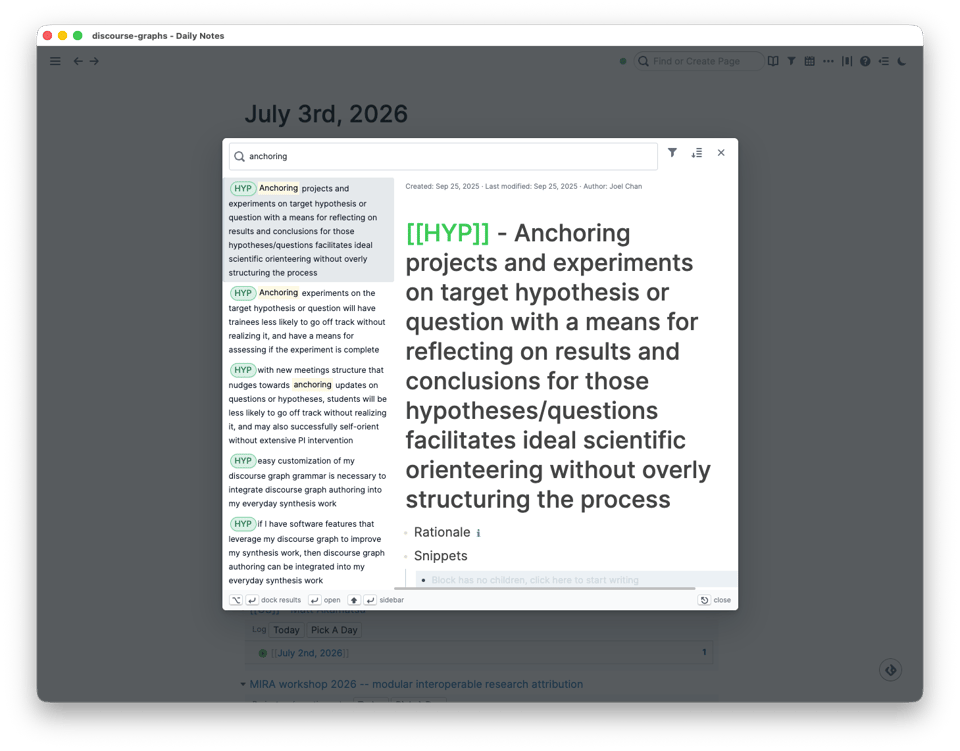
You can see the latest changes for the Roam plugin with our changelog. One notable feature in development is the Node search modal. Search across all of the nodes you’ve created from a command in the command palette. The feature is currently being tested but will be released publicly soon.
Obsidian plugin
This past month we’ve been focusing on getting the Obsidian plugin ready for release on the community plugin browser. The plugin almost passed the automatic review, but we hit one snag and had to request a manual review, so we’re hoping to see the official release of the plugin this coming month. In the meantime, you can start using it via BRAT.
Frontier panel
One of our PI’s, Joel Chan, joined a Catalyze panel to discuss how preprints, modular research, and social media are reshaping the way science gets shared, evaluated, and funded. You can watch the full recording and see the Q&A notes on our website.
MIRA 2026
Several members of our team participated in a five-day workshop with MIRA to discuss the future of modular research. At the workshop, we built proof of concepts of different tools for producing, sharing and combining modular research elements using our core schema. One example, a proof of concept for an inter-lab user story, can be seen here.
eLife Pathways joins CAIROS network
We’re happy to report that eLife Pathways has announced that they are joining the CAIROS network, a cooperative federation dedicated to building open and sustainable research commons, alongside founding members Discourse Graphs and the Cosmik Network.
Contributions
- We received and merged our first community contribution this past month to help fix some mobile loading errors in the Obsidian plugin: DiscourseGraphs/discourse-graph#1109. Thank you, Nathan!
- If you’re interested in contributing to the project, please read our guide on Github for how to do so.
- We are also open to sponsors, collaborators, and grant opportunities. Please contact us via email regarding any of those.
Thanks for reading and joining us on this journey to make science and research easier and more accessible for everyone. Until next time!